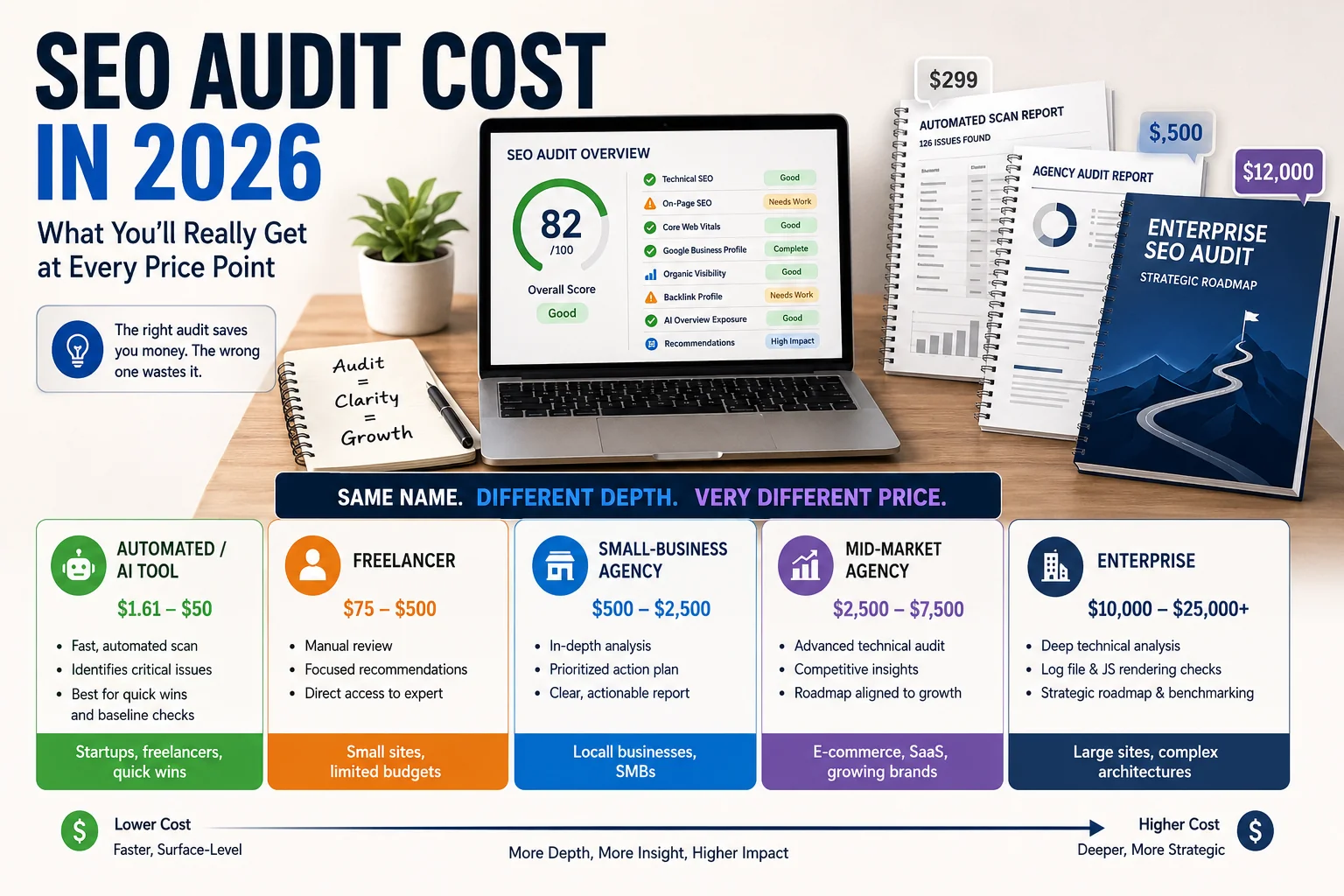
You ask three agencies for a quote. One comes back at $299. Another says $3,500. The third proposes a $12,000 engagement. All three call it an "SEO audit."
This is not an unusual experience - it's how the market works. The term "SEO audit" covers an enormous range of actual work, from a five-minute crawler export to a six-week expert engagement involving log file analysis and JavaScript rendering validation. The price spread reflects that reality. This guide untangles it: what's actually driving the cost, what each tier delivers in practice, and how to figure out which one fits your situation.
What Is an SEO Audit - and Why Is the Price So All Over the Place?
An SEO audit is a structured analysis of why a website ranks where it does and what's holding it back. A complete audit touches technical health (crawlability, site speed, mobile usability), on-page signals (title tags, heading structure, content relevance), backlink profile, and organic keyword visibility. A good one also prioritizes what to fix first - because not all issues affect rankings equally.
The reason pricing looks so inconsistent is that the word "audit" gets attached to very different products. A basic automated scan runs a crawler against your URL and returns a spreadsheet of errors. An enterprise audit involves weeks of manual work: log file analysis, JavaScript rendering checks, competitive benchmarking, and a prioritized roadmap mapped to specific business outcomes. The tool and the agency are both selling "an SEO audit." The invoice reflects the difference.
For a full breakdown of what an audit covers: What Is an SEO Audit and Why Your Website Needs One in 2026
SEO Audit Pricing in 2026: The Real Tiers
Here's how the market actually breaks down:
Audit type | Typical cost | Best for |
Automated / AI tool | $1.61 - $50 | Startups, freelancers, quick diagnostic |
Freelancer | $75 - $500 | Small sites, tight budgets |
Small-business agency | $500 - $2,500 | Local businesses, SMBs |
Mid-market agency | $2,500 - $7,500 | E-commerce, SaaS, growing brands |
Enterprise | $10,000 - $25,000+ | Large sites, complex architecture |
These aren't invented ranges. WebFX's survey data shows that 43% of businesses pay $101 to $750 for an SEO audit. Clutch data compiled by FHSEOHub puts technical audits at $100-$5,000, on-page audits at $375-$2,500, and backlink audits at $399-$1,399 - and a comprehensive audit covering all three can easily reach $5,000-$10,000 for larger sites.
The Ahrefs 2026 survey of 439 SEO professionals found the most common per-project fee sits at $2,501-$5,000, but the full range in that same survey runs from under $500 to well over $10,000. The "average" hides a 10x spread, which is exactly why generic pricing guides aren't that useful.
5 Things That Drive SEO Audit Cost Up (or Down)
Website size
The most direct cost driver. A 20-page local business site and a 50,000-page e-commerce catalog require categorically different levels of analysis. WebFX notes that site size is the single most influential factor in audit pricing - more pages means more time, and time is what you're ultimately paying for.
Automated vs. manual analysis
There's a real quality gap here. An automated report under $500 outputs a list of issues with light commentary and no strategic prioritization - useful as a starting point, not as a roadmap. An SMB-level manual audit ($1,000-$5,000) includes a proper pass on templates, indexation, and Core Web Vitals. A mid-market audit ($5,000-$15,000) adds multiple crawl comparisons, render checks, and a roadmap tied to revenue pages. The deliverable is fundamentally different. (Refact, 2026)
Scope: technical, on-page, backlink, or full
Not every audit covers the same territory. Buying only a technical audit leaves backlinks and content out of the picture. A full-spectrum audit costs more upfront but gives you a complete diagnostic - and prevents you from fixing the wrong things first.
Turnaround time
Rush delivery typically adds 20-40% to the base price. If your site isn't in crisis, standard turnaround keeps costs down. If you've just experienced a traffic drop after an algorithm update, the premium is usually worth it.
Who's doing the work
Ahrefs' 2026 survey puts US hourly rates at $71.59 for freelancers, $98.90 for agencies, and $171.10 for consultants. Agencies add project management, peer review, and overhead. Freelancers give you direct access to the person doing the work - faster iteration, less markup. AI-powered tools offer speed and consistency but less strategic interpretation. None of these is categorically better; they're suited to different situations.
How Much Does an SEO Audit Cost for a Small Business?
This is what most people actually want to know, and the honest answer is: it depends on what you need the audit to do.
If you need a professional diagnosis of your site's technical health, on-page signals, keyword visibility, and Google Business Profile - an AI-powered tool now handles that in minutes for a fraction of what a freelancer charges for the same output. SEO Audit Tool delivers a 10-section report covering PageSpeed scores, Core Web Vitals (LCP, FCP, CLS, TBT), on-page analysis, GBP completeness, organic keyword rankings, ad budget forecasting, and AI-prioritized recommendations - to your inbox, in under 5 minutes, for $1.61. No registration required. For most small businesses that need a reliable baseline before deciding on next steps, that's a better starting point than paying $500 for an automated scan with a freelancer's branding on top of it.
If you need a full manual audit with strategic recommendations from an experienced practitioner, budget $1,500-$3,000 from a freelancer or $2,500-$7,500 from a mid-tier agency. These are the ranges where you get real interpretation, not just a flagged issue list.
Either way: always ask for a sample report before you commit. Any serious provider has one.
Comparing your options? See SEO Audit Tool vs. Ahrefs - which fits your budget?
What a Professional SEO Audit Should Actually Include
The price tag tells you almost nothing about quality. A $400 report can be a genuine value or a templated export. A $4,000 engagement can be exactly what a growing e-commerce brand needs, or it can be padded hours dressed up as strategy. The question to ask isn't "how much?" - it's "what's in it?"
A professional audit in 2026 should cover all of the following:
Technical SEO - crawlability, HTTPS, mobile usability, Core Web Vitals (LCP, CLS, FCP, TBT), structured data, and indexation. In 2026, a thorough technical audit also includes entity and schema mapping and an assessment of AI Overview exposure - not just traffic volume, but whether your pages are being surfaced in Google's generative results.
On-page analysis - title tags, meta descriptions, heading hierarchy, canonical configuration, internal linking, and content-to-intent alignment. Flagged errors without recommended fixes aren't useful; any decent audit explains what to change and why.
Google Business Profile - for local businesses, this is now non-negotiable. GBP affects a significant share of local search visibility, and many audits still ignore it entirely. Profile completeness, review sentiment, competitor comparison, and missing fields should all be covered.
Organic visibility - current keyword rankings, estimated traffic, and position distribution across your target terms. This is the baseline you'll measure improvements against.
Prioritized recommendations - not a raw list of 200 issues sorted by severity score, but a clear hierarchy: what to fix first, why, and what outcome it affects. This is the element most cheap audits skip - and the one that determines whether the audit actually leads to anything.
If a provider can't show you a sample report or explain how they prioritize findings, that's a red flag regardless of price.
Free SEO Audits vs. Paid: Where the Line Is
Free tools - Google Search Console, Screaming Frog's free tier, Google PageSpeed Insights - give you raw data. They tell you what's broken. They don't tell you which broken things matter, in what order to address them, or what they're costing you in rankings.
That interpretation gap is what paid audits are selling. The problem is that price alone doesn't guarantee better interpretation. Some vendors charge $400 and deliver a 60-page crawler export. Others charge $8,500 and give you three weeks of expert-level analysis mapped to business outcomes. (Refact)
For most small businesses, the practical path is to start with a fast, low-cost AI audit that identifies the highest-impact issues, then decide whether those findings justify bringing in a freelancer or agency for targeted implementation. That sequence costs less and often produces better results than jumping straight into an expensive engagement without knowing what you're dealing with.
How Often Should You Run an SEO Audit?
The short answer: more often than most businesses do.
Most sites benefit from a full audit every 6-12 months. E-commerce and SaaS sites, where content and architecture change more frequently, should audit every 3-6 months. Beyond the calendar, there are three events that always trigger an immediate audit regardless of schedule: a site migration, a redesign or CMS switch, and any Google algorithm update that drops your organic traffic. These are the scenarios where technical issues go undetected for months and quietly cost rankings the whole time. (FHSEOHub)
At $1.29 per audit with a 25-pack from SEO Audit Tool, running quarterly audits for two years costs less than a single hour of agency consultation. There's no financial barrier to staying current.
Is an SEO Audit Worth Paying For?
An audit is a diagnostic, not a fix. Its ROI depends entirely on what you do with the findings.
The business case is straightforward. In competitive US markets, Google Ads clicks now average $5-$50+ per click - higher still in legal, insurance, and finance. Organic rankings that capture the same traffic are worth that figure multiplied by monthly clicks, compounding over time. A slow mobile load or a misconfigured canonical tag can suppress those rankings for months with no visible alert. Businesses that act on audit findings see measurable improvements in organic performance within months, and 2026 data consistently shows SEO delivering some of the highest long-term ROI of any marketing channel. (Viralchilly, 2026)
The audit is what makes the rest of your SEO investment defensible. Without it, you're optimizing without knowing where the problems are.
What Should You Actually Pay?
Three scenarios cover most buyers:
You need a fast baseline diagnostic: An AI-powered audit tool at $2-$50. You'll surface critical technical issues, Core Web Vitals failures, and GBP gaps in minutes. SEO Audit Tool covers all of this for $1.61 - no registration, no retainer.
You're an SMB or local business ready to act on findings: Budget $500-$2,500 for a freelancer or boutique agency. See a sample report first. Ask how recommendations are prioritized. Ask what they check manually versus what comes from a crawler.
You run a large e-commerce or enterprise site: A specialist agency at $5,000-$25,000+ is justified. At this scale, an undetected crawl budget issue or JavaScript rendering failure can cost far more than the audit fee in lost organic revenue.
The most common mistake isn't overpaying - it's buying the wrong tier for the situation. A $3,000 agency audit is overkill for a 15-page local business site. A $50 automated scan is inadequate for a 10,000-page SaaS product. Match the scope to the need, then evaluate providers on what the deliverable actually contains.
FAQ
How much does an SEO audit cost for a small business?
Most small businesses pay between $500 and $2,500 for a professional audit from a freelancer or agency. For a fast technical baseline - PageSpeed, Core Web Vitals, on-page signals, GBP - AI-powered tools like SEO Audit Tool deliver a complete report for $1.61.
What's a fair price for an SEO audit?
A fair price reflects the actual scope of work. For small sites, $500-$1,500 covers the essentials from an experienced freelancer. Mid-size businesses typically get full value in the $1,500-$5,000 range from a verified agency. Under $500 from an agency is almost always an automated scan, not a strategic audit.
How long does an SEO audit take?
AI tools deliver reports in under 5 minutes. Freelancer audits take 2-5 business days. Full agency engagements run 1-4 weeks depending on site complexity and scope.
What's the real difference between a $200 and a $2,000 audit?
Prioritization and interpretation. A $200 audit lists what's wrong. A $2,000 audit tells you which issues matter, why, in what order to address them, and what each fix should do for your rankings. The manual review component - someone actually reading your pages, not just crawling them - is the other key differentiator.
Are free SEO audits worth anything?
As raw data sources, yes. Google Search Console and PageSpeed Insights surface real issues. But they don't interpret findings or tell you what to fix first. A free tool is a starting point, not a substitute for a professional audit.