What Is an SEO Audit?
An SEO audit is a comprehensive analysis of your website's health from a search engine perspective. Think of it as a medical checkup for your website - it identifies what's working, what's broken, and what needs improvement to rank higher in Google.
Without an audit, you're essentially guessing what to fix. With one, you have a clear roadmap of priorities.
What Does an SEO Audit Check?
A thorough SEO audit covers multiple areas of your website. Here's what a professional audit analyzes:
1. Technical SEO
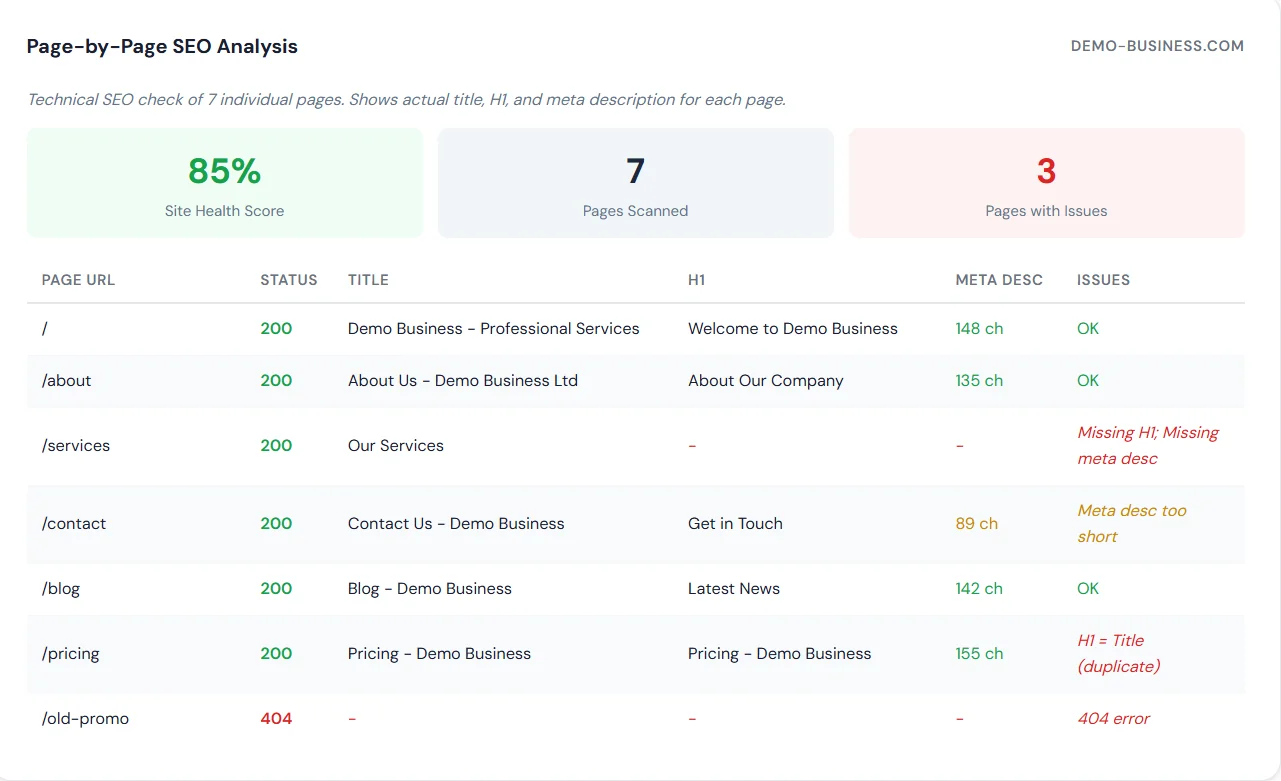
This is the foundation. Technical SEO ensures search engines can properly crawl and index your website. An audit checks:
HTTPS security - Is your site secure? Google penalizes non-HTTPS sites.
robots.txt and sitemap.xml - Can Google find and crawl all your pages?
Canonical tags - Are you accidentally creating duplicate content?
Mobile responsiveness - Does your site work well on phones?
Structured data (Schema.org) - Are you helping Google understand your content?
2. Page Speed and Core Web Vitals
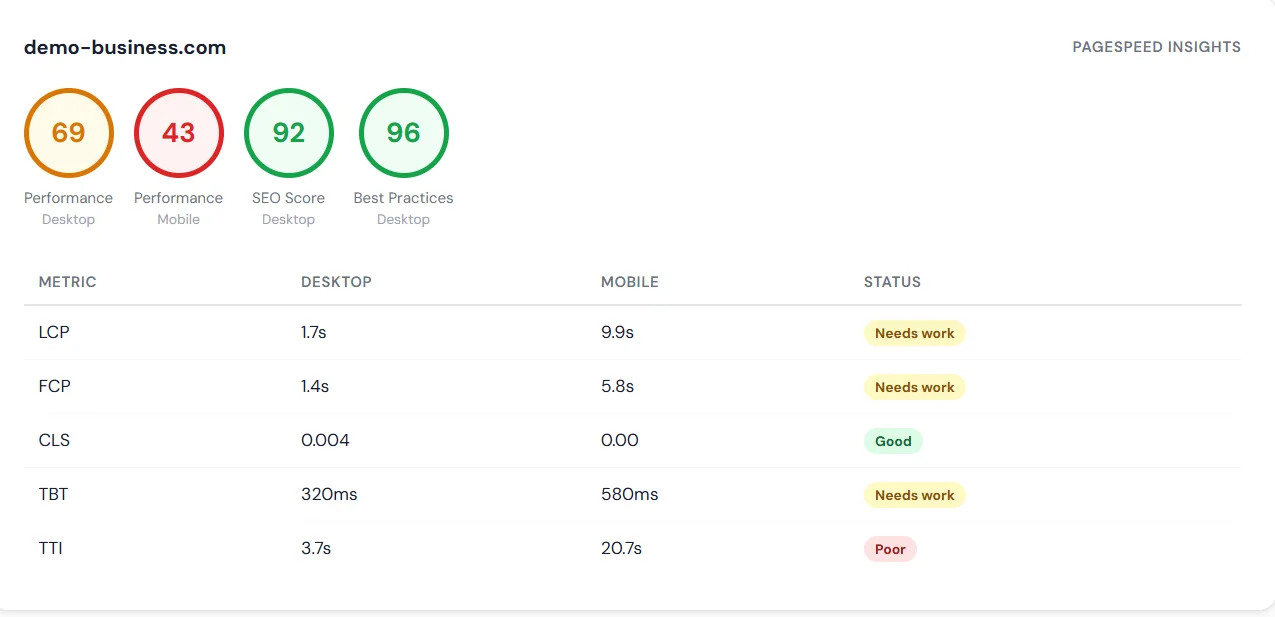
Google uses page speed as a ranking factor. An audit measures:
LCP (Largest Contentful Paint) - How fast does the main content load?
FCP (First Contentful Paint) - When does the user first see something?
CLS (Cumulative Layout Shift) - Does the page jump around while loading?
TBT (Total Blocking Time) - Is the page responsive to clicks?
These metrics directly impact both rankings and user experience. A slow site loses visitors and ranks lower.
3. On-Page SEO (Content and Meta Tags)
Content is what Google actually ranks. An audit checks:
Title tags - Are they unique, descriptive, and under 60 characters?
Meta descriptions - Do they encourage clicks from search results?
H1 headings - Does each page have exactly one clear H1?
Image alt text - Can Google understand your images?
Internal linking - Are your pages connected logically?
Word count - Is there enough content for Google to understand the topic?
4. Organic Visibility and Keywords
This section reveals how your site performs in search results right now:
Estimated monthly organic traffic
Total ranking keywords and their positions
Top keywords you rank for (and which ones you're close to page 1)
Competitor comparison - who's outranking you and why
5. Backlink Profile
Backlinks are votes of confidence from other websites. An audit analyzes:
Total backlinks and referring domains
Dofollow vs nofollow ratio
Quality of linking domains
6. Google Business Profile (for Local Businesses)
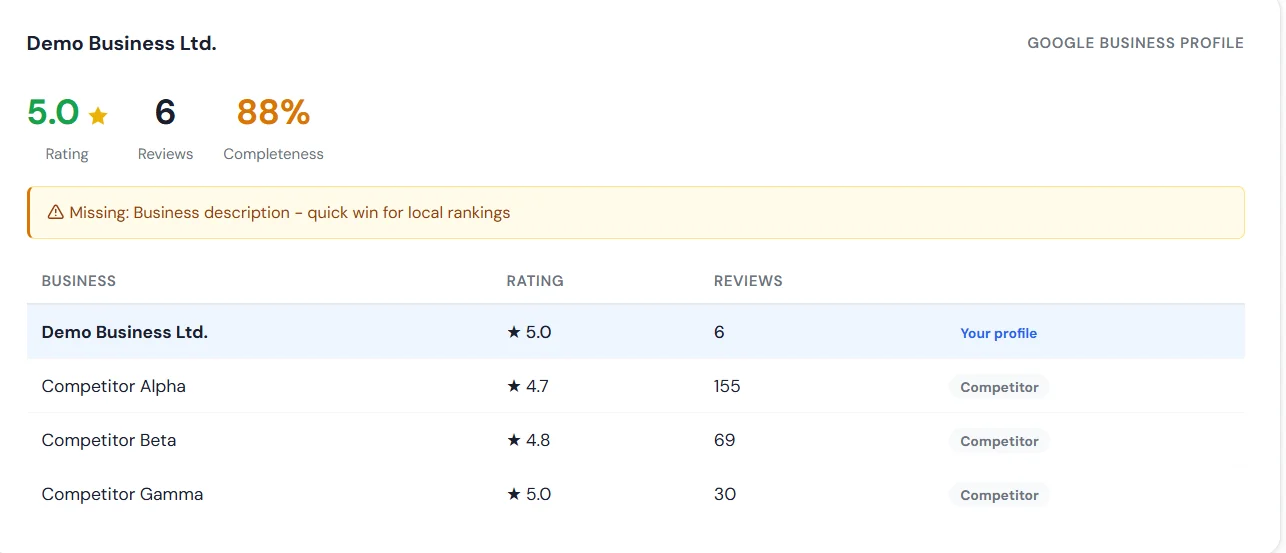
If you have a physical location or serve a local area, your Google Business Profile is critical. An audit checks:
Profile completeness score
Review count and average rating
Missing profile elements
How you compare to nearby competitors
7. Page-by-Page Analysis
Beyond the homepage, every page on your site matters. A thorough audit scans up to 30-50 individual pages checking for:
Missing title tags or H1 headings
Missing meta descriptions
Broken pages (404 errors)
Duplicate titles across pages
Why Does Your Website Need an SEO Audit?
Here are the top reasons every website owner should run an audit:
You're losing traffic you don't know about
Technical issues like broken pages, missing meta tags, or slow load times silently kill your rankings. You might be on page 2 of Google for keywords that could bring hundreds of visitors - but you'll never know without an audit.
Your competitors are doing it
If your competitors are optimizing their sites and you're not, the gap only grows. An audit shows you exactly where you stand compared to them.
It saves money on advertising
Every visitor from organic search is free. If your site ranks well, you spend less on Google Ads. An audit includes advertising budget estimates so you can see the potential savings.
It provides a clear action plan
Instead of guessing what to fix, an audit gives you prioritized recommendations - HIGH, MEDIUM, and LOW impact items. Start with the high-impact fixes and work your way down.
How Often Should You Run an SEO Audit?
At minimum, run an audit:
Every 3-6 months for active websites
After any major website changes (redesign, migration, new CMS)
When traffic drops unexpectedly
Before launching a new marketing campaign
How to Get an SEO Audit in Under 5 Minutes
Traditional SEO audits from agencies cost $500-$2,000 and take weeks. Today, AI-powered tools can deliver a comprehensive audit in minutes.
With SEO Audit Tool, you can get a professional 10-section audit report that covers everything mentioned above:
Enter your website URL and email
Optionally add your Google Business Profile link for local SEO analysis
Choose your report language (English, Slovak, Czech, German, Polish, or Russian)
Get your DOCX and PDF report delivered to your email in about 5 minutes
Your first audit is completely free - no credit card required. The report includes AI-powered recommendations and a 6-month growth strategy tailored to your specific website.
Every section is written in plain language that both SEO specialists and non-technical business owners can understand and act on.
What to Do After Your Audit
Once you have your audit report, here's how to use it effectively:
Start with HIGH priority items - these have the biggest impact on your rankings
Fix technical issues first - broken pages, missing HTTPS, sitemap problems
Optimize your content - update title tags, add meta descriptions, fix H1 headings
Follow the 6-month roadmap - the AI-generated strategy gives you month-by-month actions
Re-audit in 3 months - measure your progress and find new opportunities
Ready to Audit Your Website?
Don't let hidden SEO issues hold your website back. Get your free audit now and see exactly what needs to be fixed to improve your Google rankings.