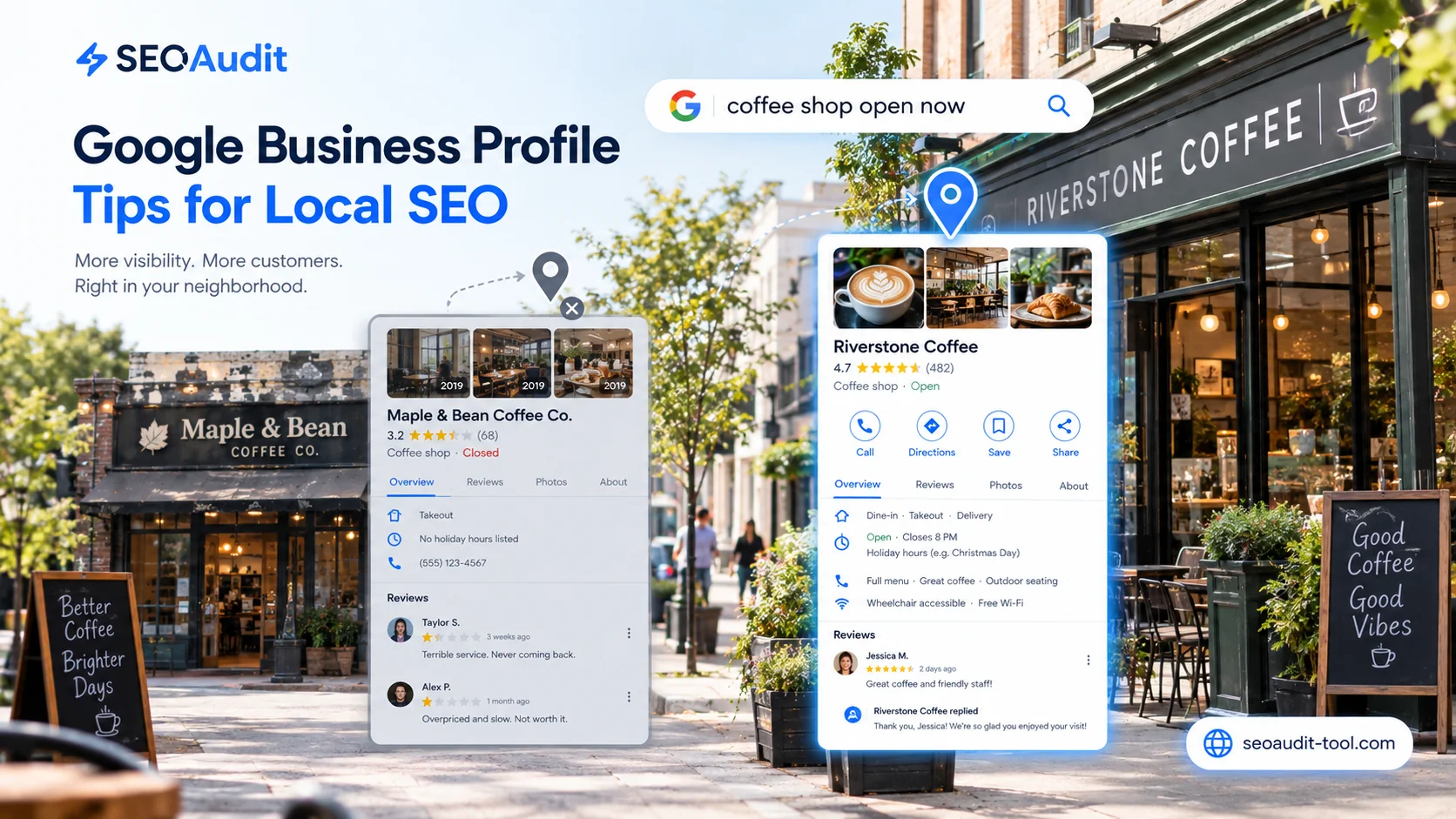
Picture two coffee shops on the same street. One has a Google Business Profile with three photos from 2019, no listed hours for holidays, and a handful of unanswered one-star reviews. The other has current hours, a full list of attributes, recent photos, and a reply under every review — good and bad. Same neighborhood, same foot traffic potential. Only one of them shows up when someone nearby searches for "coffee shop open now."
That gap isn't about budget or brand size. It's about how much attention the profile gets. For local seo for small businesses, the Google Business Profile often carries more weight than the website itself — it's what appears in Maps, in the local pack, and in mobile results the moment someone nearby is deciding where to go.
This article walks through the changes that actually move the needle, and how to find out which ones apply to your specific listing through a proper local seo audit — rather than applying a generic checklist and hoping it fits.
Why Google Business Profile Is the Backbone of Local SEO
It's entirely possible to have a fast, well-built website and still be invisible in local search. The usual reason: the website got the attention, and the Business Profile didn't.
Google is fairly direct about what drives local ranking. Its own guidance on improving local ranking points to three core factors — relevance, distance, and prominence. Relevance is how well a profile matches a given search. Prominence is shaped by completeness, review volume, and how the business is referenced elsewhere online. Distance is out of your hands. The other two aren't — and most profiles leave them noticeably unfinished.
Independent research backs this up in more detail. Whitespark's Local Search Ranking Factors study — an annual survey of dozens of local SEO practitioners scoring which signals actually move rankings — consistently groups Google Business Profile signals, review signals, and citation consistency among the categories with the strongest measurable impact on local pack visibility. That's a useful reality check: this isn't a "nice to have" checklist. It's where a meaningful share of local ranking is decided.
That's the real substance behind most local seo tips for small businesses: closing the gap between what Google is built to reward and what's actually sitting in the profile.
Core Google Business Profile Tips for Local and Small Businesses
Complete Every Field, Not Just the Basics
Almost every profile has a name, address, and phone number. Far fewer have a carefully chosen primary category, relevant secondary categories, attributes filled in (wheelchair accessible, appointment-only, outdoor seating), a full services or products list, and accurate hours — holidays included. Each field is a signal Google can match against a search. An empty field isn't neutral. It's a missed opportunity that a more thorough competitor is already claiming.
Verify the Business and Keep NAP Consistent
An unverified listing is far less likely to appear in local results at all — verification tells Google the business is real and actively managed. Just as important: the business Name, Address, and Phone number (NAP) needs to match exactly across the website, the GBP listing, and every directory it appears in. A mismatched suite number or an old phone number left on one directory sends a weaker trust signal than most owners realize.
Use Photos, Posts, and Q&A Actively
A profile with recent photos, occasional Posts, and answered questions in the Q&A section reads as actively managed — to Google, and to the person deciding whether to walk in. This doesn't require a content calendar. It requires not letting the listing go quiet for six months at a stretch.
Manage Reviews Systematically
Review count and review score feed directly into prominence — one of the three ranking factors Google names outright, and one of the categories local SEO researchers consistently rank as high-impact. Replying within a day or two, to praise and complaints alike, signals an engaged business. A thoughtful response to a bad review often builds more trust than the review itself takes away. Treating this as a weekly habit rather than an occasional cleanup is one of the simplest, most consistently overlooked local seo tips for small businesses.
How to Know If Your Profile Actually Needs Fixing
Tips are useful, but they're generic by design. A dental office, an HVAC company, and a bakery each have different gaps — different missing attributes, different competitors to benchmark against, different review patterns worth addressing first. Reading a best-practices list doesn't tell you which parts apply to your listing specifically.
That's where a google business profile audit earns its place. Instead of guessing which tips matter most, an audit checks the actual profile against what's missing, incomplete, or underperforming next to nearby competitors — turning a general list into a specific, ordered to-do list.
What a Local SEO Audit Reveals That a Manual Check Misses
Scrolling through your own listing and comparing it to a mental checklist only goes so far. A structured local seo audit places the profile next to the data that actually determines visibility: how it compares to competitors ranking for the same searches, whether reviews are trending up or down, and which fields are missing relative to the businesses currently outranking you.
Local visibility isn't only about the GBP listing, either. The website behind it still counts — page speed, mobile performance, and on-page SEO all feed into what Google calls prominence. A complete local SEO review looks at both sides together, not the profile in isolation.
How SEOAudit Tool Supports Your Local SEO Audit and GBP Support
Doing this manually means pulling data from several places — the GBP dashboard, a competitor's listing, PageSpeed results, review platforms — and comparing all of it by hand. SEOAudit Tool combines this into a single report.
It runs a full technical and on-page analysis of the website (PageSpeed scores, Core Web Vitals, HTTPS, mobile readiness, crawlability, structured data, title tags, meta descriptions, heading structure, internal linking) alongside a dedicated google business profile audit — profile completeness, review sentiment, competitor comparison, and missing fields. Organic visibility data, including keyword rankings and estimated traffic, rounds it out, and AI-generated recommendations rank the findings by impact instead of listing them with no particular order.
For businesses without an in-house SEO person who still need reliable gbp support, this offers a practical middle ground — a clear, ranked action list generated fresh each time, rather than a one-off consultation that goes out of date within a few months.
A full report — 10 sections — arrives by email in about 3 minutes, in one of 6 languages, starting at $1.61 per audit with no registration required. Businesses running audits regularly can use the 25-audit pack, bringing the cost down to $1.29 per audit with a dashboard and full audit history included. The sample report shows exactly how the GBP findings and recommendations are laid out.
Quick Checklist: Google Business Profile Essentials
All fields complete — category, hours, attributes, services
Business verified, with NAP consistent across the web
Fresh photos and active Posts
Reviews answered within 24–48 hours
Profile checked periodically against local competitors
Take the Guesswork Out of Your Local SEO Strategy
Tips only go so far without knowing which ones your specific listing actually needs. Fill in every field, verify the business, keep information consistent everywhere it appears, and stay on top of reviews — then run a local seo audit to see, in concrete terms, what's still holding the profile back compared to the competitors already outranking it.
FAQ
What is a Google Business Profile audit?
A structured review of a GBP listing that checks completeness, review sentiment, and competitor comparison, identifying specific gaps instead of relying on a generic checklist.
How often should small businesses update their Google Business Profile?
At minimum, monthly — refreshing hours, adding photos, replying to reviews, and posting updates. Listings that go quiet for long stretches tend to lose ranking momentum over time.
Do reviews really affect local SEO rankings?
Yes. Google names review count and score as part of prominence, and independent local search research consistently ranks review signals among the higher-impact factors in local pack visibility.
Where can I get GBP support if my profile isn't showing up?
Start with verification status and NAP consistency — the two most common causes. An automated audit can also flag missing fields or technical issues that are easy to miss on a manual pass.