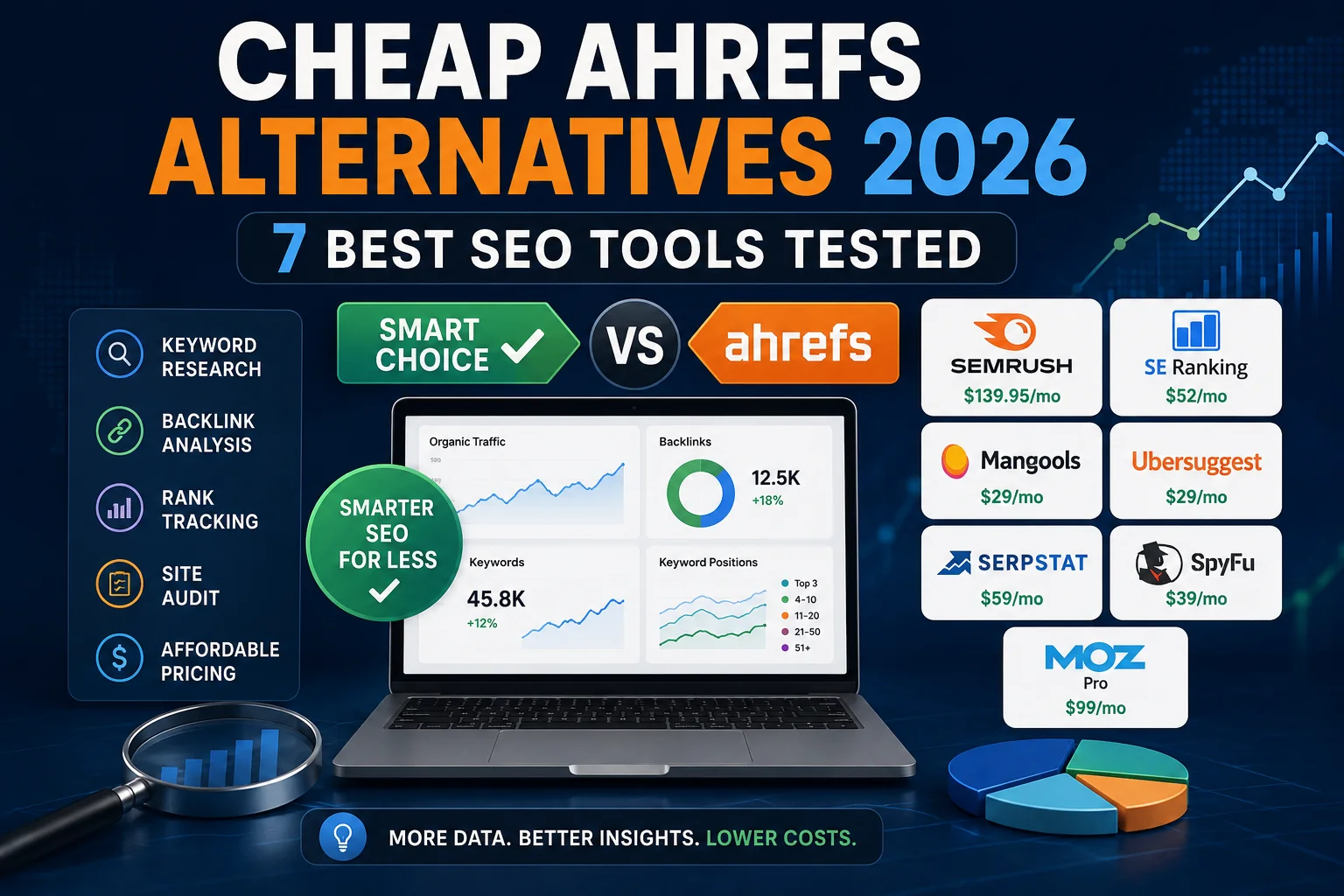
Ahrefs is one of the most capable SEO platforms available. The backlink index is industry-leading, the keyword data is deep, and the toolset covers almost every core SEO workflow. That's not in question.
The question is whether you actually need all of it - and whether the price makes sense for where you are right now.
The Lite plan starts at $129/month. Standard runs $249/month. If you need multiple user seats or API access, the real monthly cost climbs well above the listed price. There's no free trial to test before committing - Ahrefs removed its $7 seven-day trial in 2022 and hasn't brought it back. You're making a significant financial decision without a safety net.
For a funded agency billing dozens of clients, that's a reasonable tradeoff. For a freelancer managing five sites, an in-house SEO at a startup, or a blogger who needs keyword research twice a week - it often isn't.
The SEO tool market has changed. Several affordable SEO tools that cost a fraction of Ahrefs' price now cover the same core use cases with comparable accuracy: keyword research, backlink analysis, rank tracking, and site audits.
This article tests seven of them. For each tool, we cover what it does well, where it falls short, and exactly what you'll pay. No affiliate links, no ranking inflation - just a straight comparison to help you make the right call.
Who this is for: freelance SEOs, small agencies, in-house marketers, and site owners who want reliable data without an enterprise-level bill.
Why Ahrefs Is Expensive in 2026
What You Actually Pay vs. What's on the Pricing Page
Ahrefs introduced a $29/month Starter plan in January 2026, which looks like an accessible entry point. In practice, it's closer to a preview than a working tool. The Starter plan caps reports at 1,000 rows, excludes Content Explorer entirely, and doesn't include Batch Analysis. For most SEO workflows, it's not enough.
The functional plans start at $129/month for Lite. Here's the full current pricing:
Plan | Monthly Price | Projects | Best For |
Starter | $29 | 1 | Basic spot-checks only |
Lite | $129 | 5 | Solo SEOs, minimal use |
Standard | $249 | 20 | Growing teams |
Advanced | $449 | 50 | Agencies, heavy usage |
Enterprise | Custom | 100+ | Large organizations |
The listed prices assume a single user. Add team members and the cost compounds quickly. A five-person team on the Advanced plan pays $449 plus four additional seats - bringing the real monthly cost to $769, or $9,228 per year.
There's also no free trial. You can't properly evaluate the tool before paying, which adds meaningful financial risk to the decision.
One more data point worth noting for US-focused SEOs: Semrush's keyword database covers 3.8 billion US keywords compared to Ahrefs' 2.4 billion for the same market. That's not a reason to dismiss Ahrefs, but it does affect the cost-to-value calculation when US organic search is your primary focus.
The tool is genuinely powerful. The issue is that the price assumes you'll use most of what it offers - and many users simply don't.
How We Evaluated These Tools
We tested each tool against the same set of criteria using a live website with an established backlink profile and a mix of competitive and long-tail keywords in the US market. Where possible, we cross-referenced data outputs against Google Search Console to assess accuracy.
The evaluation framework is built around seven criteria that reflect real day-to-day SEO work - not feature checklists from vendor marketing pages:
Criterion | Why It Matters |
Keyword research depth | Volume accuracy, keyword difficulty scores, and US-specific data coverage |
Backlink index size & freshness | Determines usefulness for link building and competitor analysis |
Site audit quality | How reliably the tool surfaces technical SEO issues that actually affect rankings |
Rank tracking accuracy | Whether updates are daily or weekly, and how results compare to real SERP data |
Pricing transparency | Total cost including seats, overages, and add-ons - not just the base tier |
Free trial availability | Whether you can evaluate the tool before committing to a paid plan |
UI and learning curve | How quickly a solo user or small team can get actionable data without training |
Tool ratings on G2 and independent benchmark analyses from EXPERTE.com's 2026 SEO tools comparison were used as secondary reference points to validate our hands-on findings where data overlapped.
7 Cheap Ahrefs Alternatives at a Glance
Before diving into individual reviews, here's how all seven tools compare on the criteria that matter most for budget-conscious SEO work.
Tool | Starting Price | Free Trial | Best For | Backlink Index | Rank Tracking |
Semrush | $139.95/mo | 7 days | Agencies, all-in-one | ✅ Large | ✅ Daily |
SE Ranking | $52/mo | 14 days | Small teams, white-label | ✅ Good | ✅ Daily |
Mangools | $29/mo | 10 days | Beginners, bloggers | ⚠️ Limited | ✅ Yes |
Ubersuggest | $29/mo | 7 days | Solo SEOs, budget | ⚠️ Limited | ✅ Yes |
Serpstat | $59/mo | 7 days | Mid-size teams | ✅ Good | ✅ Yes |
SpyFu | $39/mo | ❌ Money-back only | PPC + SEO combo | ⚠️ Moderate | ✅ Yes |
Moz Pro | $99/mo | 30 days | US-focused, DA tracking | ✅ Good | ✅ Yes |
Prices as of May 2026. Always verify current plans directly on each vendor's website.
A few things this table doesn't show: how accurate the data actually is, how the pricing scales when you add team members, and which tools hold up under real workloads. That's what the next section covers.
7 Best Cheap Ahrefs Alternatives: Detailed Reviews
Semrush - Best All-in-One Alternative
What it does well
Semrush covers more ground than any other tool on this list. Keyword research, backlink analysis, technical site audits, rank tracking, content optimization, and paid search data all live in one dashboard. For agencies that need to manage multiple clients across SEO and PPC without switching platforms, that consolidation has real operational value.
On keyword data specifically, Semrush has a measurable edge over Ahrefs for US-focused work: 3.8 billion US keywords in its database compared to Ahrefs' 2.4 billion. If organic search in the American market is your primary focus, that difference shows up in keyword discovery - particularly for long-tail and question-based queries.
Where it falls short vs. Ahrefs
Ahrefs' backlink index updates faster - closer to real-time - while Semrush refreshes on a daily cycle. For active link building campaigns where new links matter immediately, that gap is noticeable. The interface is also considerably more complex, which increases onboarding time for smaller teams.
Pricing
The Pro plan starts at $139.95/month for one user. Guru runs $249.95/month. Both are less expensive than Ahrefs Standard or Advanced when you factor in the breadth of features included. A 7-day free trial is available with no credit card required on some signup flows.
Best for: Digital agencies and in-house teams that need SEO, content, and paid search data in a single platform.
Verdict: The most direct Ahrefs competitor on this list - broader in scope, stronger for US keyword research, and more cost-effective for multi-discipline teams.
SE Ranking - Best Value for Growing Teams
What it does well
SE Ranking consistently stands out as the alternative that delivers connected, actionable data rather than isolated metrics. Rank tracking, backlink monitoring, keyword research, and site audit are all integrated - changes in one area surface relevant signals in others. The white-label reporting feature is particularly strong, allowing agencies to produce client-ready reports without additional software.
The 14-day free trial is one of the more generous offers in this category and gives enough time to run a real project through the platform before committing.
Where it falls short vs. Ahrefs
The backlink index is solid but not as deep as Ahrefs or Semrush for large-scale link prospecting. If your primary workflow is competitor backlink analysis at scale, you'll hit limitations faster than you would on Ahrefs Standard. Historical data depth is also more restricted on lower-tier plans.
Pricing
Plans start at around $52/month for the Essential tier, scaling to $95/month for Pro and $207/month for Business. Pricing adjusts based on keyword tracking volume, which keeps entry costs low for teams with focused tracking needs. Annual billing brings an additional discount.
Best for: Small agencies managing up to 15-20 clients, in-house SEO managers who need reporting they can share directly with stakeholders.
Verdict: The strongest value proposition on this list for teams that need a complete, integrated SEO workflow without paying Ahrefs prices.
Mangools - Best for Beginners and Bloggers
What it does well
Mangools bundles four focused tools - KWFinder, SERPWatcher, LinkMiner, and SiteProfiler - into a clean, approachable interface. KWFinder is its standout feature: it's particularly effective at identifying long-tail keywords with low competition scores, and the location targeting works well for local SEO use cases. For someone getting started with keyword research, the learning curve is minimal and the data is presented in a way that's easy to act on immediately.
At $29/month, it's also the most affordable entry point among tools that provide genuinely useful keyword difficulty and volume data.
Where it falls short vs. Ahrefs
The backlink index is significantly shallower. LinkMiner provides a basic view of who is linking to a domain, but it's not suitable for serious link prospecting or competitive backlink analysis. Site audit functionality is limited compared to Ahrefs, SE Ranking, or Semrush. If technical SEO or link building is a core part of your workflow, Mangools will feel restrictive.
Pricing
The Entry plan starts at $29/month (billed annually). Basic runs $49/month, Premium $69/month. A 10-day free trial is available. No per-seat pricing complications - plans cover a fixed number of daily searches.
Best for: Bloggers, niche site builders, and content creators who primarily need reliable keyword research and basic rank tracking.
Verdict: An excellent starting point for keyword-focused work, but not a full Ahrefs replacement if backlinks or technical audits are part of your regular workflow.
Ubersuggest - Best Budget Pick for Solo SEOs
What it does well
Ubersuggest covers the core bases - keyword suggestions, basic backlink data, site audit, and rank tracking - at a price point that's hard to argue with. The lifetime deal option (a one-time payment instead of monthly billing) makes it uniquely attractive for solo operators who want to eliminate recurring software costs. The interface is straightforward, and the keyword data is adequate for low-to-mid competition niches.
Where it falls short vs. Ahrefs
Crawl depth on the site audit is limited, and the backlink index is noticeably smaller than Ahrefs, Semrush, or even SE Ranking. Keyword data for highly competitive US markets can feel thin, and the rank tracking update frequency is slower than daily on lower plans. It's a tool that covers basic needs reliably - it doesn't match Ahrefs on data depth in any category.
Pricing
Individual plans start at $29/month or $290 as a one-time lifetime payment for one website. Business plans covering up to seven sites run $49/month or $490 lifetime. The 7-day free trial requires a credit card.
Best for: Freelancers managing fewer than five client sites, solo content marketers, and budget-conscious beginners who need basic SEO data without monthly overhead.
Verdict: The lifetime pricing makes Ubersuggest a practical choice for solo SEOs, but treat it as an entry-level tool rather than a direct Ahrefs replacement.
Serpstat - Best Mid-Range Platform
What it does well
Serpstat hits a useful middle ground between budget tools like Mangools and full-scale platforms like Semrush. Its keyword clustering feature is one of the better implementations in this price range - grouping related keywords by topic rather than listing them individually, which makes content planning significantly more efficient. The site audit is thorough and surfaces technical issues in a clear priority order. Competitor keyword gap analysis works well for identifying content opportunities quickly.
Where it falls short vs. Ahrefs
Content execution isn't part of Serpstat's core offering - it provides the research and audit layer but requires separate tools for content writing or optimization. Backlink data, while useful, doesn't match Ahrefs in terms of index size or refresh speed. The interface has improved but can still feel cluttered compared to more focused tools.
Pricing
Plans start at $59/month for Individual, scaling to $119/month for Team and $479/month for Agency. A 7-day free trial is available. Annual billing reduces costs by roughly 20%.
Best for: Mid-size in-house teams and agencies that need keyword clustering, site audit, and competitor analysis without paying for features they won't use.
Verdict: A capable mid-range platform that delivers meaningful SEO research and audit functionality at a price well below Ahrefs Standard.
SpyFu - Best for PPC + SEO Combined Research
What it does well
SpyFu's core strength is competitor intelligence - specifically the combination of organic keyword data and paid search history in the same interface. You can see which keywords a competitor has been bidding on over time, which organic terms they rank for, and where the overlap between their paid and organic strategy lies. For performance marketers running both channels, this cross-channel view saves significant time compared to maintaining separate tools. At $39/month, it's one of the most affordable options that provides genuine competitor research depth.
Where it falls short vs. Ahrefs
The backlink index is more limited than Ahrefs, Semrush, or SE Ranking. Rank tracking and site audit features are functional but not the primary reason to use SpyFu. If your workflow is primarily technical SEO or content-driven link building, other tools on this list will serve you better. SpyFu also doesn't offer a conventional free trial - there's a money-back guarantee instead.
Pricing
Basic starts at $39/month. Professional runs $79/month. Team plans are $299/month. Annual billing is available with a discount. No free trial, but the money-back guarantee reduces commitment risk.
Best for: Performance marketers and SEO/PPC specialists who need a single tool for competitive keyword research across both organic and paid channels.
Verdict: Narrow in focus but genuinely strong at what it does - the most practical option for anyone running organic and paid search in parallel.
Moz Pro - Best for US Domain Authority Tracking
What it does well
Moz Pro offers the longest free trial on this list at 30 days - enough time to run multiple real projects through the platform and make an informed decision before paying anything. Domain Authority (DA), Moz's proprietary metric, remains one of the most widely referenced signals in US link-building outreach. Whether or not DA perfectly reflects ranking potential, it's a shared language in the industry that makes prospecting conversations easier. The keyword research and rank tracking tools are reliable and well-suited to the US market.
Where it falls short vs. Ahrefs
Data updates are slower than Ahrefs or Semrush, which matters for active campaigns where link velocity or ranking shifts need to be tracked quickly. The backlink index, while reasonable, is not as comprehensive as Ahrefs' at comparable price points. The toolset is solid but covers less overall ground than Semrush or SE Ranking.
Pricing
Starter plan at $99/month covers one user and 10 tracked campaigns. Medium runs $179/month, Large $299/month, and Premium $599/month. Annual billing saves around 20%. The 30-day free trial is the most generous evaluation window in this category.
Best for: US-focused SEOs, link building specialists who use DA as a core prospecting metric, and teams that want a risk-free evaluation period before committing.
Verdict: Not the most feature-dense option, but the 30-day trial and strong US market focus make it a low-risk starting point for teams new to paid SEO tools.
Which Tool Should You Choose?
The right tool depends on your workflow, team size, and which SEO tasks you actually do every day. Here's a straightforward breakdown.
If you are… | Use this |
A solo blogger or niche site builder on a tight budget | Mangools or Ubersuggest |
A freelancer managing fewer than 5 client sites | Ubersuggest (consider the lifetime deal) |
A small agency with up to 10 clients | SE Ranking |
An in-house SEO who needs to share reports with stakeholders | SE Ranking |
Running SEO and PPC in parallel and need competitor intelligence | SpyFu |
An agency needing SEO + content + paid search in one platform | Semrush |
New to paid SEO tools and want to evaluate risk-free | Moz Pro (30-day trial) |
A US-focused SEO who needs the deepest keyword database | Semrush |
Scaling up and need enterprise backlink data without Ahrefs pricing | Semrush Advanced or SE Ranking Business |
A few additional considerations worth factoring in before you decide.
If backlink monitoring is your primary use case, none of these tools fully match Ahrefs on index freshness or depth. SE Ranking and Semrush come closest, but if near-real-time backlink data is critical to your workflow, Ahrefs may still be the right call despite the cost.
If you're unsure where to start, use the trial period productively - run your actual workflow, not a demo. Moz Pro gives you 30 days. SE Ranking gives you 14. Pull data on your own site and a direct competitor, and see whether the results hold up against what you already know.
If you're currently combining two or three single-purpose tools, do the math before assuming that's cheaper. SE Ranking or Semrush frequently costs less in total than running separate keyword research, rank tracking, and audit tools side by side.
The goal isn't to find the cheapest option. It's to find the one that covers your specific needs without paying for features you won't use.
A Fast Alternative for Pre-Audit and Quick SEO Checks
While most tools in this list are designed for ongoing SEO workflows - keyword research, backlink tracking, and rank monitoring - there is another category worth mentioning: fast, lightweight audit tools built specifically for quick diagnostics.
One example is SEO Audit Tool (AI-powered), which focuses on instant website analysis rather than full-scale SEO management. Instead of requiring setup, project configuration, or crawling limits, it works in a simpler flow: you enter a URL and receive a structured SEO audit report within minutes.
The goal here is not to replace platforms like Ahrefs, Semrush, or SE Ranking, but to complement them at an earlier stage of decision-making. In many cases, users don’t need a full subscription before understanding what’s wrong with their site. They need a quick way to identify critical issues such as indexation problems, missing metadata, Core Web Vitals issues, broken internal links, or mobile usability errors.
The output is structured into prioritized findings, which makes it easier to quickly assess whether a site is technically ready or whether deeper optimization work is required before investing in a full SEO platform.
In practice, this type of tool fits well in two scenarios: before choosing a long-term SEO suite, and before launching or auditing a site where speed of feedback matters more than depth of data.
What You'll Miss Without Ahrefs
This article makes a case for cheaper alternatives - but that case has limits. Here's what you give up when you move away from Ahrefs.
Backlink data freshness
This is the most significant practical difference. Ahrefs refreshes its backlink index every 15-30 minutes. Every other tool on this list updates on a daily cycle at best. For most SEO workflows - monthly reporting, content audits, general keyword research - daily updates are perfectly adequate. But if you're running active link building campaigns, monitoring competitor link velocity, or tracking the impact of digital PR in near-real time, that gap matters. No cheaper alternative has closed it.
Content Explorer
Ahrefs' Content Explorer is a genuinely unique research tool. It lets you search across billions of indexed pages by topic, filter by traffic, backlinks, publishing date, and domain rating, and identify content gaps or link opportunities at a scale that other platforms don't replicate. SE Ranking and Semrush have content research features, but they work differently and with less depth. If Content Explorer is a core part of your workflow, you'll notice its absence immediately.
Historical data
Ahrefs Standard and above give access to extensive historical backlink and keyword data - useful for understanding how a site's authority has changed over time, identifying lost links, or auditing the history of a domain before acquisition. Most alternatives restrict historical data on lower-tier plans or don't offer the same range.
Keyword data breadth across international markets
While Semrush has more US keyword data, Ahrefs covers 217 locations compared to Semrush's 142. For SEOs working across multiple international markets simultaneously, that global coverage is a real advantage.
If backlink monitoring at scale, Content Explorer, or multi-market international keyword research are central to your daily work, Ahrefs is likely still worth the cost. For the majority of SEO tasks - keyword research, rank tracking, site audits, US-focused competitor analysis - the alternatives in this article cover the gap at a fraction of the price.
Free Ahrefs Alternatives Worth Knowing
Paid tools aren't the only option. If your budget is zero or you need to supplement a paid plan with additional data sources, these three free tools cover specific SEO tasks reliably.
Google Search Console
The most underused free SEO tool available. GSC shows you exactly which queries are driving impressions and clicks to your own site, how your pages rank across different search terms, and which pages have indexing or coverage issues. The data comes directly from Google, which makes it more accurate for your own domain than any third-party estimate. It doesn't cover competitor research or backlink prospecting, but for monitoring your own organic performance it has no equal.
Ahrefs Webmaster Tools
A free tier from Ahrefs itself - available to anyone who verifies ownership of a domain. It gives you access to backlink data and organic keyword performance for your own site, with no cost and no time limit. The limitation is scope: you can only analyze domains you own. You can't research competitors or prospect for link opportunities. As a free backlink monitoring tool for a site you manage, it's genuinely useful.
Google Keyword Planner
Available free with any Google Ads account. Volume data is US-accurate and sourced directly from Google's own search data, which makes it reliable for US market research. The main drawback is that volume figures are shown in ranges rather than exact numbers unless your account has active ad spend. Keyword difficulty scores aren't included, so it works best alongside another tool rather than as a standalone research solution.
These free tools are worth using regardless of which paid platform you choose. That said, none of them cover competitive research, cross-site backlink analysis, or technical audits. For those workflows, a paid tool is necessary - and the options in this article start at $29/month.
A Note on Sources and Methodology
The pricing figures, feature details, and tool comparisons in this article are based on a combination of direct testing, vendor documentation reviewed in May 2026, and two independent third-party sources.
G2 - Ahrefs Pricing & Reviews (2026) - G2's aggregated review data was used to cross-reference real user sentiment on Ahrefs pricing and value. The consistent pattern across hundreds of verified reviews: high ratings paired with cost concerns. Users in marketing, IT, and small business segments repeatedly describe Ahrefs as expensive but justifiable for daily professional use - while flagging pricing as the primary reason they evaluate alternatives. That pattern directly informed how we framed the cost-value analysis in this article.
EXPERTE.com - SEO Tools Comparison (April 2026) - EXPERTE.com's independent benchmark tested major SEO platforms across backlink index size, crawl speed, data accuracy, and feature depth. Their analysis confirms Ahrefs as a technically strong platform with industry-leading backlink data - and also identifies specific areas where alternatives perform comparably at lower price points. We used their findings as a secondary validation layer for our hands-on tool assessments.
All pricing in this article was verified against official vendor websites in May 2026. SEO tool pricing changes frequently - always confirm current costs directly with the provider before making a purchase decision.
The SEO tool market in 2026 looks different than it did three years ago. Cheaper alternatives have closed the gap on Ahrefs in the areas most SEOs use daily - keyword research, rank tracking, site audits, and competitor analysis. For the majority of workflows, you don't need to pay $249/month or more to get reliable, actionable data.
The right choice depends on what you actually do. SE Ranking for growing teams, Semrush for all-in-one coverage, Mangools or Ubersuggest if budget is the primary constraint. If backlink monitoring at scale is your core workflow, Ahrefs may still be worth the cost. For everything else, the alternatives in this article deliver.
Before committing to any paid platform, start with what you know for certain: the current technical state of your site. Run a free site audit with SEOAudit Tool to identify your highest-priority issues first - then choose the tool that helps you fix them.
FAQ
What is the cheapest Ahrefs alternative that still gives accurate data? SE Ranking starts at $52/month and covers keyword research, link monitoring, and technical crawls with daily position updates. For most small teams, the accuracy is comparable to Ahrefs on core tasks. Mangools at $29/month is the lowest-cost option, though its link database is limited.
Is there a free alternative to Ahrefs? Not a direct one. Ahrefs Webmaster Tools is free for verified site owners and shows link and organic keyword data for your own domains. Google Search Console covers organic performance from Google's side. Neither supports competitor research or link prospecting - for those, a paid tool is necessary.
Which Ahrefs alternative is best for US keyword research? Semrush. Its US database contains 3.8 billion search queries compared to Ahrefs' 2.4 billion for the same market. That difference surfaces most clearly when researching long-tail and question-based queries in competitive American niches.
Can any of these tools replace Ahrefs for link building? Partially. SE Ranking and Semrush come closest on link index size and update frequency, but Ahrefs refreshes its link graph every 15-30 minutes - none of the alternatives match that. For general link prospecting and monitoring, SE Ranking or Semrush are sufficient. For active outreach campaigns where real-time verification matters, the gap is real.
Does Ahrefs have a free trial in 2026? No. Ahrefs removed its paid trial in 2022 and hasn't reinstated it. The $29/month Starter plan is the lowest-risk way to evaluate the platform, though it has significant restrictions on report depth and feature access.
Which tool is better for a small agency: Semrush or SE Ranking? SE Ranking is the more practical choice for most small agencies. It's less expensive, includes white-label reporting, and pricing scales with keyword tracking volume rather than charging a flat per-seat rate. Semrush makes more sense if the agency also manages paid search and needs a single platform for both channels.
What SEO tool is best for a solo blogger on a budget? Mangools at $29/month covers keyword difficulty scoring, search volume, and basic position tracking with a clean interface and minimal learning curve. If you want to avoid recurring costs altogether, Ubersuggest's one-time lifetime deal ($290 for one site) is worth considering.