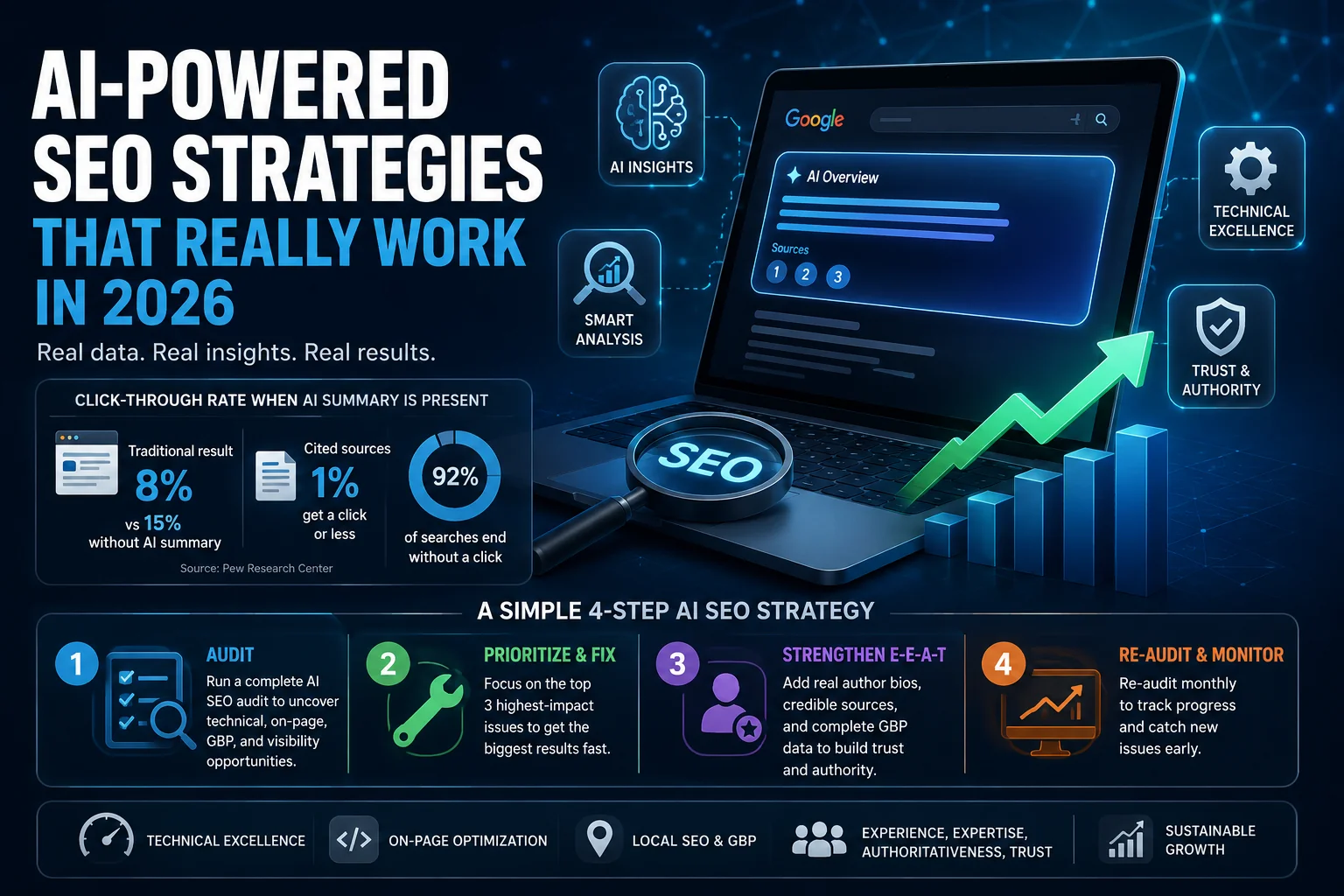
Here's a number worth sitting with: according to a March 2025 Pew Research Center study, people click a traditional search result only 8% of the time when an AI summary appeared on the page, compared to 15% when it didn't. Clicks on sources cited within AI summaries were even rarer - only about 1% of browsing sessions included a click on a cited link.
That's the search landscape SEO now operates in. AI Overviews and AI Mode aren't a future risk to plan around; they're already reshaping which sites get found and which get skipped. Naturally, an entire industry of "AI SEO" advice has sprung up to respond - some of it useful, a lot of it recycled hype dressed up as a new discipline.
This article sticks to what's actually verifiable: what Google has said officially, what current data shows, and which AI-powered SEO strategies actually hold up once you test them. Along the way, we'll point out where a structured AI SEO audit fits into a realistic workflow, and what separates genuinely useful SEO analysis from advice that just sounds impressive.
Why "AI SEO" Doesn't Mean What Most People Think
Part of the confusion comes from mixing up two very different things: using AI to generate content, and using AI to analyze it. The second is where most of the real value sits - and it's also the part Google has now weighed in on directly.
On May 15, 2026, Google published its first official, consolidated guide on this exact question: Optimizing your website for generative AI features on Google Search, announced through the Google Search Central Blog. The message is refreshingly unambiguous - AI Overviews and AI Mode run on the same core ranking and quality systems as standard search. There's no separate "AI optimization layer" to install on top of good SEO. There's just SEO, applied well or applied poorly.
That's a useful filter for evaluating any AI SEO tactic you come across: does it strengthen the fundamentals, or does it just repackage them under a new acronym? A well-built AI SEO audit should do the former - turn a long list of theoretical issues into a short list of the ones actually costing you visibility.
The Foundation: Technical SEO Still Decides Who Gets Seen
Before any AI-specific tactic matters, the basics have to hold up. Google's guide confirms that generative AI features pull from the same index and rely on the same technical quality signals as classic search - meaning Core Web Vitals, crawlability, HTTPS, mobile performance, and structured data are still gatekeepers, not extras on a checklist.
This is where most sites lose visibility without ever noticing:
Mobile Core Web Vitals (LCP, INP, and CLS) are often dramatically worse than desktop scores. Google evaluates these field metrics using Chrome UX Report (CrUX) data over a rolling 28-day window, meaning a strong Lighthouse result alone doesn't guarantee good real-world performance. Aim for LCP under 2.5 seconds, INP under 200 milliseconds, and CLS below 0.1.
Structured data is missing, incomplete, or broken, so Google can't confidently interpret what a page is actually about
Crawl issues quietly block entire sections of a site from being indexed at all
Running a technical ai seo audit - one that checks PageSpeed, Core Web Vitals, HTTPS, mobile experience, crawlability, and structured data as a single connected picture rather than isolated line items - is usually the fastest way to catch these before they compound. It's the first layer covered in SEOAudit Tool's report, and it's typically where the cheapest, highest-impact fixes turn up.
On-Page Signals That AI Systems Actually Read
Google's guide also quietly debunks a few popular assumptions. You don't need special AI-only files, markup, or "chunked" content to appear in generative AI features - Google's systems already handle multi-topic pages and surface the relevant section on their own. That also includes llms.txt. Despite growing interest around the file, Google has stated that AI features don't require llms.txt, AI-specific markup, content chunking, or rewritten "AI-friendly" pages. The same technical and content quality signals that support traditional Search continue to determine visibility in AI Overviews and AI Mode.
What genuinely matters on-page:
Title tags and meta descriptions that describe the page accurately, rather than functioning as keyword containers
Logical heading structure that mirrors how a knowledgeable person would actually explain the topic out loud
Entity clarity - using the correct, recognized names for products, tools, and concepts, since AI systems interpret meaning through entities and relationships, not just repeated phrases
Internal linking that connects related pages into a coherent cluster, helping both crawlers and AI summarization understand context
None of this requires guesswork. Reliable SEO insights come from actually seeing which pages are missing these signals - not from assuming what "should" be working based on last year's playbook.
E-E-A-T in the AI Era: Why Author Credibility Now Affects Rankings
Google's March 2026 core update reinforced something that had been building for a while: content needs demonstrable Experience, Expertise, Authoritativeness, and Trust - not just factual accuracy, as outlined in Google's own Creating Helpful, Reliable, People-First Content documentation. Industry E-E-A-T research has repeatedly found that pages with detailed, verifiable author bios tend to outrank near-identical content published under a generic "Editorial Team" byline, especially for competitive queries.
What actually moves the needle:
A real author name with a short, specific bio on every article
A link to a verifiable professional profile - published work, a speaker page, a LinkedIn history that matches the claimed expertise
First-hand detail where it's relevant: a screenshot, a specific number, an actual example - rather than only synthesizing what other sites already say
This part is manual, and it should stay that way. AI can flag that a byline is missing or generic; it can't decide who the author is or vouch for what they've actually done.
Brand Mentions Beyond Your Website
Google's guidance also notes that AI-powered Search can draw on information published about your business across the web - including articles, reviews, videos, forums, and other third-party sources. That makes authentic brand mentions increasingly valuable. While businesses can't control these discussions directly, earning credible coverage, expert reviews, customer testimonials, and genuine community mentions strengthens the signals AI systems use when evaluating reputation and authority.
Local Signals: The Overlooked Piece of AI-Powered SEO Strategies
For any business with a physical location or service area, Google Business Profile data feeds directly into local AI-generated answers. Profile completeness, review sentiment, and how a business compares against nearby competitors all shape whether it gets surfaced at all.
This is often the most neglected part of an SEO strategy, mainly because it lives outside the website itself and gets forgotten during content-focused audits. A full AI SEO audit that includes GBP analysis - missing fields, weak review sentiment, competitor gaps - closes a blind spot that on-site optimization alone can't fix.
How to Actually Use AI Tools in an SEO Workflow
AI tools earn their keep in three areas: diagnosing technical and on-page issues at scale, ranking those issues by likely impact, and forecasting outcomes - like ad budget needs based on CPC and competition data. They're far less useful for brand voice, editorial judgment, or deciding which E-E-A-T signals matter most for a specific audience. That still takes a person.
A well-designed audit reflects this split. Instead of a wall of generic advice, it should produce a prioritized list - which issues to fix first, based on estimated impact, rather than a flat checklist where everything looks equally urgent. That distinction is what separates a report full of noise from one that delivers clear recommendations you can act on this week, not someday.
How Google Recommends Evaluating AI SEO Tools
In June 2026, Google expanded its SEO guidance by publishing recommendations on how businesses should evaluate third-party SEO tools, services, and advice. Rather than encouraging AI-specific shortcuts, Google recommends choosing tools that improve decision-making, prioritize meaningful issues, explain their recommendations clearly, and support long-term website quality instead of promising guaranteed rankings.
These are useful benchmarks for evaluating any AI SEO platform. A good audit tool shouldn't just generate dozens of warnings - it should explain which problems matter most, why they matter, and what to fix first. That's the approach SEOAudit Tool follows by combining technical diagnostics, on-page analysis, Google Business Profile insights, and prioritized recommendations into a single workflow.
How to Check Whether Your Site Appears in AI Overviews
Before optimizing for AI-powered Search, establish a baseline. The simplest approach is to manually search your highest-value queries in an incognito window on both desktop and mobile, noting whether an AI Overview appears and whether your website is cited within it. Repeat the process for your core commercial, informational, and branded keywords, since AI Overviews don't appear for every search.
For larger sites, dedicated SEO platforms can track AI Overview visibility across hundreds of keywords, making it easier to monitor changes over time instead of relying on occasional manual checks. Whether you check manually or use a tool, the goal is the same: identify which queries trigger AI Overviews, whether your pages are cited, and how that visibility changes as you improve your content.
A Simple Four-Step AI SEO Strategy You Can Run This Month
Run a full audit covering technical SEO, on-page structure, GBP (if applicable), and organic visibility to establish an honest baseline.
Fix the top three highest-impact issues first. Prioritization beats volume - most sites don't need forty fixes, they need the right three.
Strengthen E-E-A-T signals - real author bios, sourced claims, complete GBP data - since these now tie directly to ranking outcomes.
Re-audit monthly to confirm changes are working and catch new regressions before they quietly cost you rankings.
This cycle is deliberately unglamorous. It doesn't require a large team or budget - a single AI SEO audit run on a monthly cadence is often enough to keep a site aligned with what's actually changing in search.
Common Mistakes That Undermine AI-Powered SEO Strategies
Publishing AI-generated content without editorial review. Google's own guide states plainly that non-commodity, first-hand, expert-led content outperforms generic, synthesized summaries in generative AI features.
Chasing keyword density instead of natural language. Google doesn't use keyword density as a ranking factor. If you're counting keyword occurrences, you're optimizing for an outdated metric instead of writing content that clearly addresses the user's search intent.
Optimizing only for desktop. Mobile Core Web Vitals are frequently far worse and reflect what most real visitors actually experience.
Treating SEO as a one-time project. A single audit shows where things stand today. It says nothing about three months from now, when the next core update lands.
AI-powered SEO strategies hold up when they're built on what's always mattered - technical accuracy, clear on-page structure, demonstrable expertise - with AI used to spot problems faster and prioritize fixes more precisely. The tools make the site's condition visible. What you do with that visibility still comes down to editorial judgment.
If you want a concrete starting point rather than a general sense that "something" needs fixing, running a structured AI SEO audit across technical SEO, on-page factors, GBP, and organic visibility takes a few minutes and gives you an actual list to work from.
FAQ
What is an AI SEO audit?
A technical and content analysis - Core Web Vitals, on-page structure, structured data, often GBP data - where AI processes the data and ranks the resulting recommendations by likely impact.
Is AI SEO a different discipline from traditional SEO?
No. Google's May 2026 guidance confirms generative AI features run on the same core ranking systems as standard search, so technical health, on-page clarity, and E-E-A-T still apply.
Do AI Overviews make SEO less important?
No - they change where the value shows up. Being the source an AI system chooses to cite still depends on the same quality and technical signals that drive traditional rankings.
How often should a site be audited with AI tools?
Monthly is a practical cadence for most sites - frequent enough to catch regressions without creating audit fatigue.
Does Google penalize AI-generated content?
Not simply for being AI-assisted. It deprioritizes generic, unreviewed, commodity content - the fix is editorial oversight and genuine first-hand input, not avoiding AI tools altogether.